Canton Network vs ZKsync: Why Institutions Choose Canton
Canton and ZKsync are both technically serious. They serve different markets. Here is why Goldman Sachs, JPMorgan, and DTCC chose Canton for institutional settlement: and where ZKsync wins.
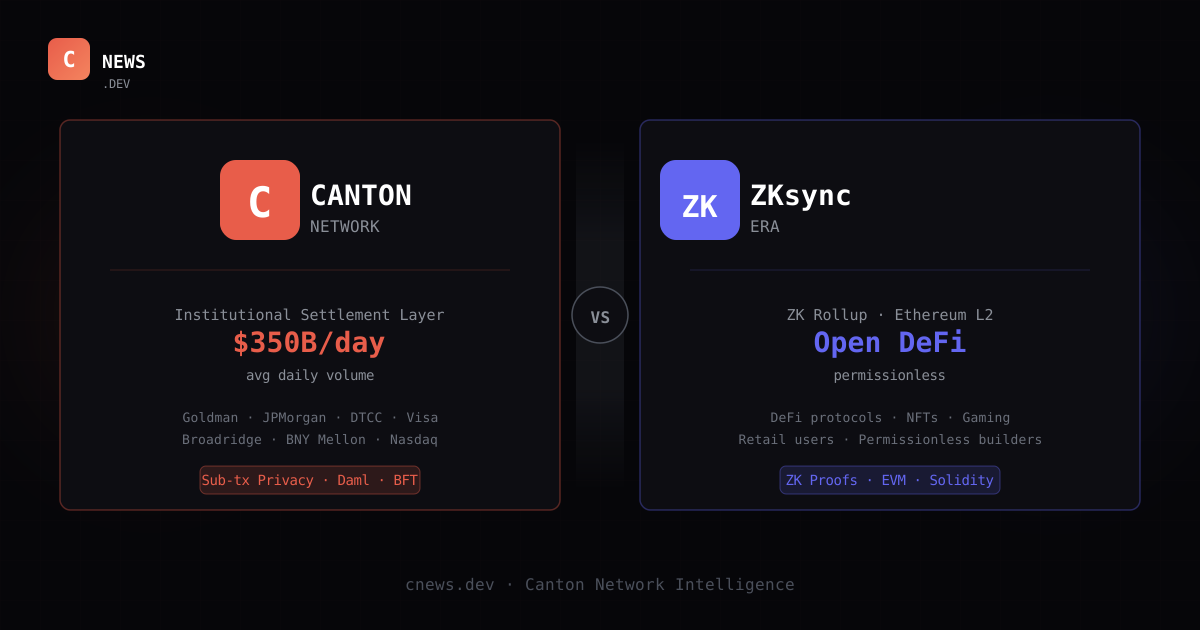
Two of the most technically sophisticated blockchain protocols in production today solve different problems for different users: and the comparison reveals exactly why $350 billion moves daily through Canton Network while ZKsync serves a fundamentally different market. This is not a flaw in either. It is a category difference that most "blockchain comparison" coverage misses entirely.
Canton Network launched its Global Synchronizer mainnet on July 1, 2024, under the Linux Foundation. ZKsync Era went live on mainnet in March 2023. Both are serious engineering efforts. But when Goldman Sachs, JPMorgan (Kinexys), DTCC, and Broadridge needed infrastructure to settle regulated assets at institutional scale, they chose Canton. Understanding why requires looking at the specific properties each protocol optimizes for: and who those properties serve.
The Core Architectural Difference
ZKsync is built on a foundational crypto premise: trustless computation via zero knowledge proofs. ZK proofs allow ZKsync to prove correct transaction execution to Ethereum without publishing transaction data. This is genuinely powerful for DeFi applications where users need cheap computation but are comfortable with Ethereum's public data model.
Canton's architecture starts from a different constraint: regulated financial institutions cannot share counterparty data across an open network. When Goldman Sachs books a repo trade with JPMorgan, the terms of that trade: notional amount, collateral, rate: cannot be visible to Broadridge, BNY Mellon, or any third party who runs a Canton validator. Sub-transaction privacy is not a feature Canton adds on top of a public ledger. It is the protocol's foundational design guarantee, enforced by Daml, the smart contract language Canton uses.
Daml contracts specify privacy at the type level: every contract defines which parties are signatories (bound by its terms), observers (entitled to see it), and controllers (authorized to exercise it). The Canton runtime enforces these boundaries at transaction execution time. A validator processing a repo settlement sees that a valid transaction occurred: it does not see the collateral, the rate, or the counterparties. That enforcement happens in the execution engine, not in an access control layer someone could misconfigure.
Head to Head Comparison
| Criteria | Canton Network | ZKsync |
|---|---|---|
| Privacy model | Sub-transaction privacy: parties see only their own data, enforced at language level | Public by default. ZK proofs protect computation validity, not content confidentiality |
| Validator admission | Permissioned Super Validator set (institutional qualification required) | Permissionless: anyone can participate as a validator or user |
| Smart contract language | Daml: compliance native, rights and obligations model, built for legal contracts | Solidity/EVM: built for permissionless DeFi, largest developer ecosystem |
| Settlement finality | Atomic, deterministic: cross institution settlement with 2/3 BFT consensus | Probabilistic. ZK proof generation adds latency before Ethereum finality |
| Regulatory compliance | GDPR compliant data pruning: parties can remove private historical data | Cannot remove onchain data: permanent public ledger |
| Institutional traction | Goldman Sachs, JPMorgan (Kinexys), DTCC, Broadridge ($280B avg daily), Visa, BNY Mellon | Growing DeFi ecosystem: no comparable TradFi institutional deployment |
| Daily volume | $350B+ tokenized asset movement (network wide) | $50–200M DeFi TVL range |
| Token model | CC: activity based rewards, fee burn, no pre mine or VC allocation | ZK. VC backed, inflationary emissions, standard governance token structure |
Why Canton Wins on Institutional Criteria
1. Privacy is non-negotiable for regulated finance. A $280 billion daily repo book cannot sit on a public ledger. Broadridge's Distributed Ledger Repo platform: the world's largest institutional platform for tokenized asset settlement, processing $5.9 trillion monthly as of August 2025: runs on Canton precisely because the privacy model allows counterparties to settle without exposing their books to the network. ZKsync's architecture proves that computation happened correctly, but the inputs to that computation are visible to anyone who reads the chain. For most DeFi applications, that is fine. For repo trading between regulated institutions, it is not.
2. Daml is purpose built for legal contracts. Solidity was designed for permissionless DeFi: simple token transfers, AMM pools, lending protocols. It is excellent at that. Daml was designed to model legal agreements: two parties, specific rights, explicit obligations, deterministic settlement. When DTCC builds infrastructure for DTC custodied tokenized U.S. Treasury securities, the contract language needs to express concepts like "only the registered owner can initiate transfer" and "the custodian must co-authorize any collateral movement." Daml expresses these as first class language features. Solidity requires reimplementing them in application code where they can be gotten wrong.
3. Atomic cross institution settlement without bridge risk. Canton's Global Synchronizer provides atomic settlement across participant domains: a trade either settles in full across all counterparties simultaneously, or it does not settle at all. No partial settlement, no bridge contracts, no layered trust assumptions. ZKsync's cross chain interoperability involves bridge infrastructure: which means bridge risk. The major crypto bridge exploits of 2022–2024 collectively lost billions of dollars. Canton's atomic model eliminates the category of risk entirely.
4. Existing institutional relationships that took decades to build. Canton did not convince Goldman Sachs to join. Goldman Sachs helped build it. GS DAP, Goldman's Digital Asset Platform, is natively built on Canton. Goldman participated in the March 2024 Canton pilot alongside BNY Mellon and Cboe for tokenized asset settlement and fund registry. JPMorgan's Kinexys announced a phased rollout of JPM Coin on Canton in January 2026. These organizations evaluated Canton against every alternative and made infrastructure commitments. That is not marketing: it is institutional due diligence concluding in deployment.
Where ZKsync Wins
Being direct about this matters. ZKsync is not a failed product losing to Canton: it is a different product serving a different market, and it does its job well.
ZKsync wins on developer accessibility. EVM compatibility means millions of Solidity developers can deploy on ZKsync without learning a new language. The permissionless validator model means anyone can build and deploy without institutional qualification. Retail DeFi applications. DEXes, lending protocols, yield products, NFT platforms: are natural fits for ZKsync's architecture.
ZKsync wins on credible neutrality. No institution controls ZKsync. No Goldman Sachs sits on a validator committee. The network governs itself through token based governance, and its neutrality is verifiable precisely because it is permissionless. For applications where users need to trust that no single institution can influence the network's operation, ZKsync's architecture is more appropriate than Canton's.
ZKsync wins on developer community size. The Solidity/EVM ecosystem dwarfs Daml in terms of available developers, tooling, documentation, and protocol primitives. Building a consumer DeFi application on ZKsync in 2026 is faster and cheaper than building the equivalent on Canton.
Different Categories, Not a Horse Race
On April 3, 2026, Evgeny Gaevoy of Wintermute: appearing on the same Chopping Block episode that featured extensive Canton skepticism: made the clearest articulation of this distinction: Ethereum and its L2 ecosystem are the credibly neutral layer. Canton is the institutional settlement layer. These are not the same category. The question is not which is better: it is which you need.
If you are a hedge fund running a permissionless options protocol, you need ZKsync or a similar public EVM chain. If you are DTCC building infrastructure for U.S. Treasury settlement that must comply with SEC regulations, GDPR, and AML frameworks simultaneously, you need Canton.
The $350 billion daily onchain asset movement that Canton processes is not consumer DeFi: it is institutional repo, tokenized money market funds, digital bond issuance, and regulated asset settlement. Broadridge's $280 billion average daily repo volume alone represents a substantial fraction of that figure, and Broadridge is a public company that discloses those numbers to the SEC. The data does not require trust in Canton Foundation marketing: it is independently verifiable through Broadridge's public filings.
The Canton Coin Distinction
CC, Canton's native token, reflects the same design philosophy. There was no ICO, no pre sale, no VC allocation. Every CC in circulation was earned through network participation: validator operations, application usage, user activity. The fee burn mechanism permanently destroys all transaction fees (denominated in USD, paid in CC), running at approximately $2.4 million per day as of April 2026. Total burned supply has passed 2.5 billion CC.
ZK, ZKsync's governance token, launched with a substantial VC backed allocation and standard inflationary emissions. This is a conventional Web3 token structure: not inherently worse, but structurally different from Canton's activity based model with no insider allocation.
The token structures match the networks' institutional priorities: Canton needed to demonstrate that its economics were not designed to enrich insiders at institutional participants' expense. A zero pre mine, activity rewarded model addresses that concern directly. ZKsync, serving a consumer DeFi market where VC backed teams are standard, had no equivalent constraint.
Which One Should You Watch
For traders and investors, the relevant question is which market each protocol is capturing. ZKsync competes in a market: consumer DeFi on Ethereum L2s: that is intensely competitive, with Arbitrum, Base, Optimism, and others fighting for the same developer and user base. Canton operates in a market with fewer direct competitors for institutional settlement infrastructure on a public L1 with sub-transaction privacy and atomic cross institution settlement.
Canton's pipeline for H1 2026 includes DTCC's U.S. Treasury tokenization MVP and the continued JPM Coin rollout through Kinexys. Neither of those is a DeFi product competing with ZKsync. They are settlement infrastructure products that ZKsync's architecture cannot serve, by design.
That is the comparison. Two technically serious protocols, two different markets, two different winning conditions. The institutions settling $350 billion per day are not confused about which one they need.